My preparation for combat airlift in Vietnam began years
earlier.
Duke required two years of
AFROTC
so I endured it. I didn't have much money for college and I
wasn't eager to be drafted, so a college scholarship and an Air
Force commision were appealing. My junior year at University
of Florida I got an
AFROTC
scholarship, which meant that if I did well I'd be
commissioned as a
second
lieutentant; if not I'd be enlisted as an airman. One
way or the other, I'd be in the Air Force two years hence.
My senior year I enrolled in AFROTC Flight Instruction Program
(FIP). I learned to fly a
Piper
Cherokee and the USAF learned that I was worth sending to
pilot training. Pilot training would mean spending 5 years in
the military rather than 4, but the Air Force was all about flying
airplanes and I wanted to be on the first team. My FIP was at
Sieg Field, near Gainesville. It had a 2,000' grass strip and
a wooden shack that could hold two people. After 20 hours of
flying I earned my private pilot's license.
Most ROTC graduates received a reserve commission, but I did well,
and when I graduated from UF the Air Force gave me a regular
commission. They sent me a hundred miles up the road to
Moody
Air Force Base in Valdosta, Georgia--next to the Okeefenokee
Swamp. This was my first real assignment--Undergraduate Pilot
Training--the year of 53 weeks.
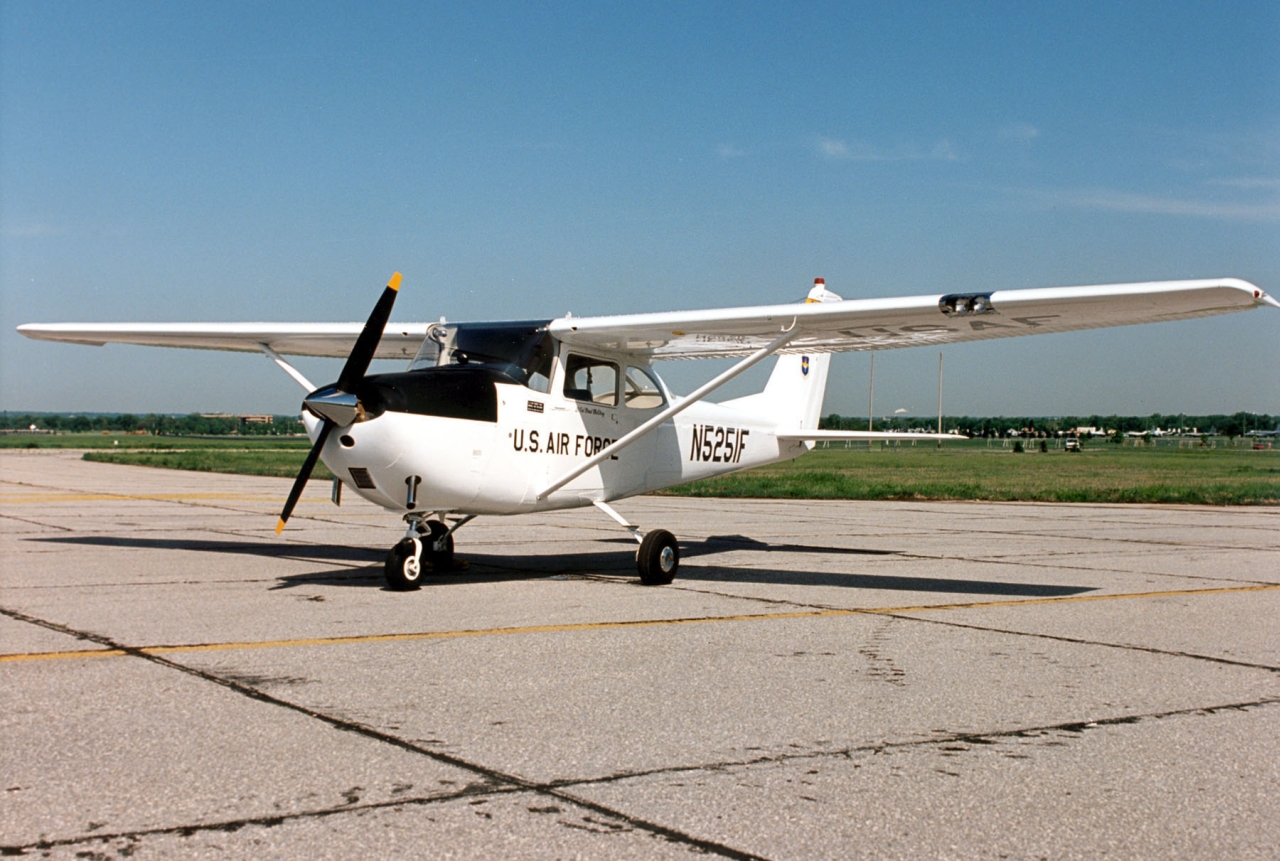
First I flew the
T-41
(a Cessna 172 without wheel pants), nicknamed the "Attrition
Machine". The instructors were civilians and we flew out of
Valdosta
Municipal Airport. The Air Force wanted to weed out
students at low cost before investing a lot of time and money.
It worked.
My T-41 instructor was "Similin' Jack" Fletcher, who was a former
Air Force fighter pilot and a genuine hardass. He was the lead
T-41 check pilot, so the one good thing about having him as your
instructor was that you couldn't have him as your check pilot.
He was the only teacher who ever made me cry.
There was plenty of machismo among pilot training "studs". One
day we were told we were going to watch a gory film about first
aid. The sergeant said anyone who felt queasy during the movie
should just put his head between his knees and wait for the lights
to come up. We students exchanged knowing glances and chuckles
indicating our toughness. When the lights came up there
were quite a few guys with their heads between their knees.
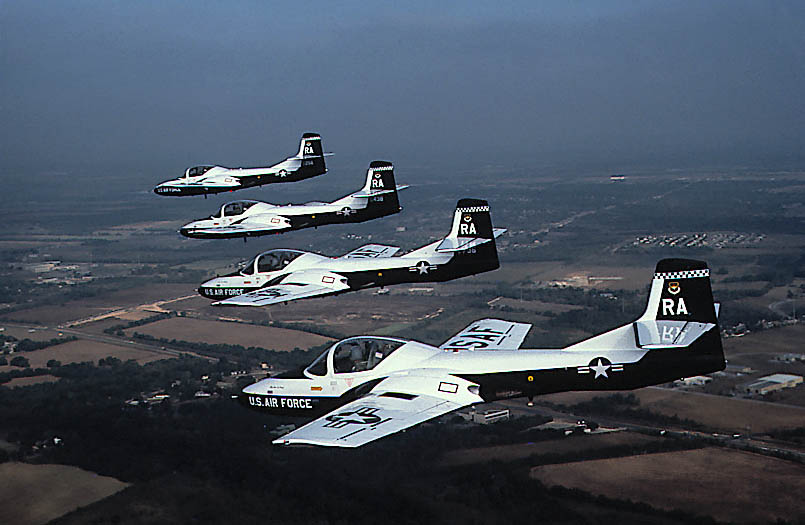
Next we flew 5 months in the
T-37
"Tweetie Bird" and that's when we really learned aviation--emergency
procedures, oxygen, parachutes, ejection seats, jet engines,
hydraulics, fuel management, instrument flying, aerobatics,
formation flying.
We learned how high-G maneuvers (loop, cloverleaf, split-S, etc.)
can drain the blood from your brain. When you pull more G's
than your body is ready for, you get tunnel vision. When you
pull even more G's, you grey out--you're still conscious, but
blind. When you pull even more G's you black out--go
unconscious. That's how Hartford, Connecticut's Bradley
Airport got its name--
its
namesake
blacked
out
in
a
high-G maneuver and augered in.
We got pretty accustomed to tunnel vision--it told us to back off a
little. Once I flew solo when I wasn't feeling well and I
blacked myself out. When I went unconscious I apparently
released the stick, which reduced the G-load. I woke up some
seconds later with the airplane in a steep bank and heading for the
ground. I shook for a little bit, flew some lazy 8's, then
returned to base.
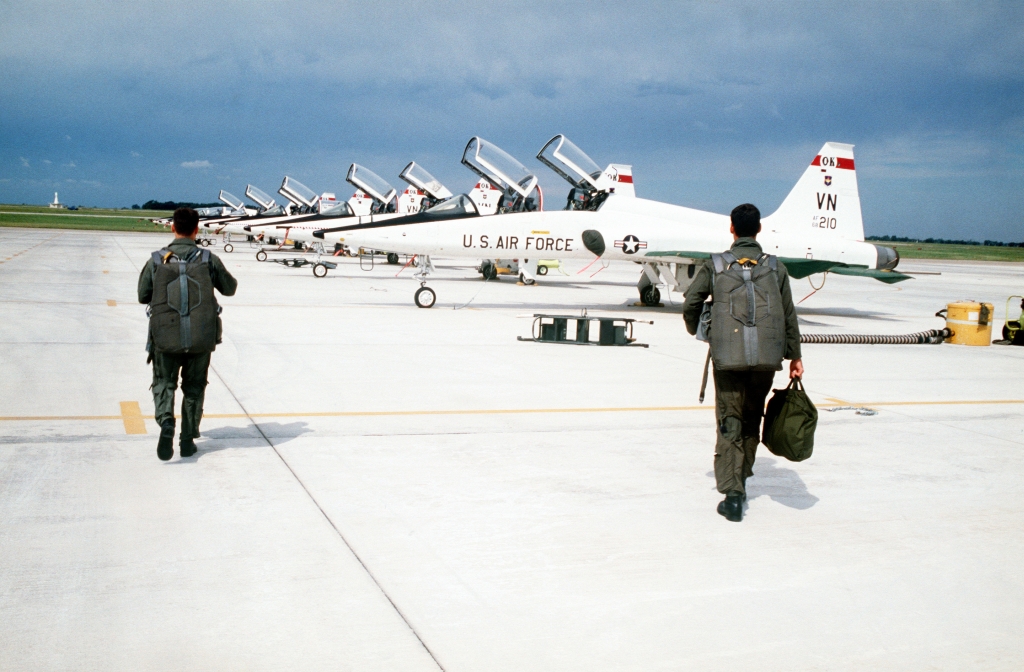
Finally we flew 6 months in the supersonic
T-38
"White Rocket". Everything happens twice as fast in a T-38 as
in a T-37 and four times as fast as in a T-41. For example,
its
landing speed is faster
than the
top speed of the
T-41! The T-38 is quite unforgiving of sloppiness or
relaxation. It also has a high pilot workload--if you are
flying along straight and level not doing anything, you probably
just forgot to do something important. If you can make this
airplane do what it is capable of, you get your wings.
Many of my classmates washed out. One student had over a
hundred flying hours before he arrived at Moody. He could
certainly fly the T-41; he just couldn't do it
The
Air Force Way, so he washed out. One student had been
knocked out for a few seconds during a basketball game at the Air
Force Academy. He was washed out because he admitted he had
been unconscious at some point in his life. Another student
just couldn't get the hang of formation flying. One clanked up
during a parachute landing and broke his leg. Others simply
failed check rides.
For those who persevered, class standing determined your
assignment. If you were #1 you got first pick from the block
of assignments. If you were last, you got the least desirable
assignment. I was pretty high in the class so I got my second
choice--a
C-141
Starlifter at Travis
Air Force Base, California.
The war took the lives of
five
graduates of Moody AFB class 69-01.